"It may be that when we no longer know what to do we have come to our real work, and that when we no longer know which way to go we have come to our real journey. The mind that is not baffled is not employed. The impeded stream is the one that sings." – Wendell Berry
You don’t have to follow the path that stretches out before you (as far as the eye can see).
Here, the path curves inward. You don’t have to see where it leads.
You only have to stop.
Stay here awhile.
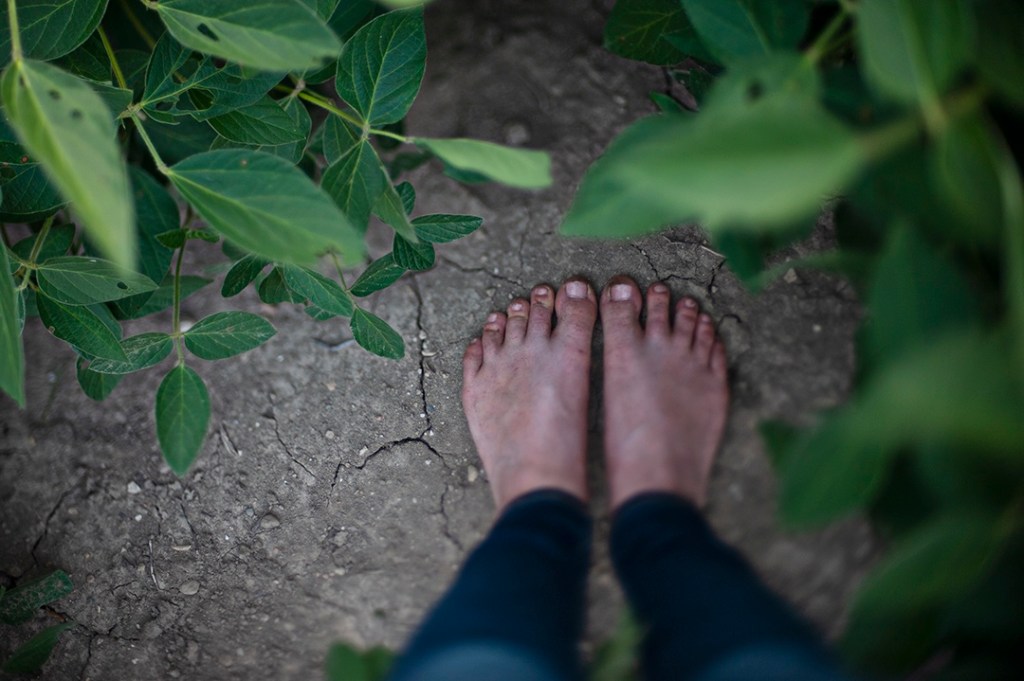
Take off your shoes and press your feet into the earth.
The path inward begins where your feet are: close to the ground, beneath the cacophony of voices beckoning you forward.
Let gentleness be your guide. She knows the way in.
You’ve spent so much time searching: between pages of books, between palms pressed together, between pews and postures and pixels on screens. Scrolling. Scrolling. Blue light limning some deeper longing.
Searching for somewhere other than here; something other than this.
But the thing you’ve been searching for has always been here, has always been this:
your feet in the dirt, your heart knocking against the walls of your chest, between this breath and the next.
I once read that at twenty-weeks gestation, a female fetus has already developed a reproductive system containing all of the eggs she will ever produce. If this is true, then a part of me already existed almost seventy years ago: the tiniest matryoshka doll nestled in the womb of my mother in the womb of my grandmother.
So much of what I remember about my grandmother has already slipped away. But I remember her eyes, cornflower blue, passed on to my mama and my second-born daughter, Millie. I remember how she absentmindedly tugged on one of her earlobes and how, as a child, I was equal parts intrigued and horrified that her right earlobe hung three-quarters of an inch lower than the left.
She made the best molasses cookies and always had the kettle boiling for a cup of tea. She loved science and theology, history and literature, and her voracious appetite for books gave her an outlet for these passions. When I was twelve, she handed me a copy of Betty Smith’s A Tree Grows in Brooklyn, and in the days that followed, as I poured over the book’s pages, I learned about acceptance and tenacity and the power of story.
I used to spend Monday afternoons at my grandma’s house while we waited for my sister’s piano lessons to let out. One afternoon, I leaned against the yellow formica countertop of her small kitchen peninsula, intently scraping the last of the Cheez Whiz out of the jar with a butter knife. My grandma fixed her eyes on me. I was still wearing my Catholic school uniform: my bare, freckled knees sticking out between my white knee-socks and my black tartan kilt.
“You’re built like me,” she wheezed, her blue eyes meeting my own. “You don’t have those aristocratic genes your sister inherited from your father. We can trace our lineage back to potato farmers, you know.”
She drummed her gnarled hands on her knees.
“Our sturdy, thick legs are perfect for digging up potatoes.”
I licked the butter knife, unsure of how to respond. She fumbled around on the table for her cigarettes.
“Wide hips come in handy for birthing babies, that’s for sure.”
I think she meant the words as a genuine compliment, but at fourteen I didn’t care about strong legs or birthing hips. With clumsy fingers, I unrolled the waistband of my kilt so the hem fell below my kneecaps.
Sometimes I wonder why we lose so many memories, yet retain the ones we do: small puzzle pieces that fit together to tell the fragmented story of a life.
Our time on earth is made of memories. They are fleeting and ineffable, yet they are also tangible, carnal things experienced through the very real sensations of our bodies. More than our thoughts we are muscle and sinew, blood and bone, hair and teeth. When I try to remember the very first days of motherhood, for example, they don’t just exist in my mind. The memories are imbued with physicality. The searing pain of transition, the tearing of tender flesh, the pins-and-needles let down of milk, the tiny gnawing jaw at my breast, the sweaty, furred head tucked beneath my chin, the milky, sweet smell of the folds of my infant’s neck, the constant thirst, the full body exhaustion, the full heart expansion.
Our bodies won’t always be here. But there are physical parts of us that remain even after we’ve gone back to the earth. The traits my grandmother passed down: my daughter’s blue eyes, my sturdy, freckled-legs—she is still alive in these small ways, just as I was physically alive inside of her decades before I ever existed in this particular form.
We think in terms of binaries and dualisms. We separate our minds from our bodies, our memories from our present moments. Our minds may process our memories, but our bodies feel them. Human life is imbedded in the very fibres of the sensual world in which we live our lives.
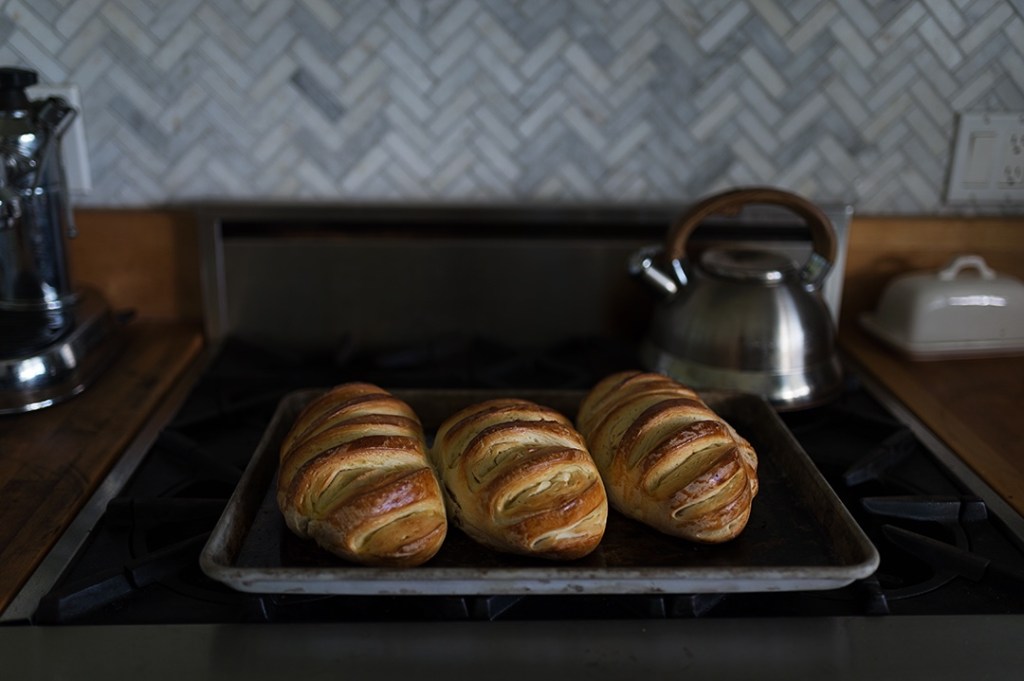
I want it all. The taste of freshly baked bread in my mouth and the memory of its fragrance still filling my senses. The quick brush of my lips against my twelve-year-old’s head as she walks by me in the kitchen, and the felt memory of these same lips on her soft, pulsing fontanel when she was just minutes old. This delight. This pain. This unbridled laughter. These unapologetic tears. This confusing, convoluted, achingly beautiful solid-yet-light thing we call life. This. All of it.
There are four years of my life that don’t exist in photographs. I thought by destroying every single one I could somehow erase that part of me. It worked for a while, but like a fossil suddenly exposed on a creek bank after layers of protective earth had eroded away, my past became visible. It seemed sudden and unexpected, but it wasn’t really.
Hidden things can’t stay hidden forever.
Fossils are exposed by erosion and excavation: some buried for millions of years. Our past selves are what? Years old? Maybe decades?
They layers they hide beneath are thinner than we think.
The gap between staying hidden and being exposed is a diaphanous membrane. It’s only a matter of time before that membrane disintegrates. Our choices are erosion or excavation. Both choices are hard as hell.
We can keep the self we want to hide tucked away, and let life slowly wear us down until we’re left raw, vulnerable and exposed, wondering how it happened when we’d hidden it so well. OR we excavate ourselves. WE do the HARD WORK of digging, our shoulders held back with the fierce beauty of resilience.
When the vestiges of our past selves are exposed in this way, WE control the narrative of our own story.
I’m writing these words from the other side of my own excavation. The digging can be a path to healing. And friend, you don’t have to bear the load alone. You can find a guide for the journey.
A few years ago, I worked with a therapist who took me across the terrain of my past, handed me a shovel and said, “Dig here.”
I dug until my hands were raw and blistered and the fossils of my past selves were laid bare. They had borne the crushing weight of my own shame for too many years. I looked at them in that moment, simultaneously fractured and whole; preserved for all those years, waiting for me to recognize not just their brokenness, but their beauty.
Sometimes things need to stay hidden for a time. Our bodies find a place to hide the traumas from our pasts until we are ready to look at them with a little distance, a shift in perspective. Our bodies whisper to us, “Hush, now. Don’t worry. Hide yourself here for awhile. I’ll take care of you. Come back when you are ready. You are safe. You are safe. Darling, you are safe.”
Snakes have vestibular ear parts, but unlike humans they have no outer ears, no ear canals—just inner ears.
For years this baffled scientists and they hypothesized snakes were deaf and the inner ears were just some useless remnant from the snakes’ evolutionary past.
New science tells us that snakes CAN hear sound in their inner ears—it’s transmitted through their skin and through vibrations in their skull.
There’s a story in Greek mythology about a soothsayer, Melampus. He raised two orphaned snakes after finding their mother crushed beneath a cart. As thanks, they licked his ears while he was asleep, making him able to understand the language of all animals.
The story doesn’t elaborate on what the sensation of hearing animals was like for Melampus, but I wonder how he heard? Were the voices translated into his own human tongue? Or did his hearing become like a snake: more somatic, instinctual, animal?
Maybe true listening begins with attention. Melampus recognized the young snakes were in distress and showed them attention; in turn, they granted him the ability to truly hear.
Pre-pandemic, I had anxiety about gathering in large groups. I always felt scattered, half-listening to one conversation, my other ear tuned to what was going on around me. It was impossible to be present with my mind spread in so many directions and to listen without knowing how to direct my attention. I’ve always preferred the safe spaces of a few intimate friendships where we skip over all the small-talk and engage with the deepest parts of ourselves. Even in online spaces I find myself drawn past the noise to the voices which speak to the tender insides of things.
I don’t feel a need to have a voice in every conversation, but I can listen with bodily awareness. Where do these words speak to the deepest parts of me? Can I feel them vibrating on my skin? Through my skull? In the softness or constriction of my belly? Does my heart rend because of injustice? Human suffering? How do I respond? Where am I directing my attention?
My children have been making time capsules. They fill mason jars with treasures: tiny clay and felted creatures, drawings, poems and starling feathers collected beneath the bird feeder in our front yard.
I stand alongside my daughter as she combs the ditch for the perfect smooth stone to pack into her jar.
I watch her search. I am searching, too.
The children bury their jars in the wildflower meadow with plans to unearth them in some far off future which they can’t yet imagine.
I don’t need a jar for my treasures. I have lived long enough to know that I, too, am a time capsule. I hold within me all of my past selves—preserving moments, years, decades inside my skin. Within me is every version of myself I have ever been. They shift and move to make room for each other as each new self emerges. Each one is preserved: waiting to be sistered, mothered, held, seen.
I gather all of them in my arms even as they shift and change in my attempt to grasp. To understand.
I force myself to look at my most broken self. She’s barely twenty, looking at her reflection in a mirror on the wall of a dingy basement apartment. She’s just cut her waist length hair with a pair of dull kitchen shears. It’s piled in looping copper ribbons at her feet. Her grandmother’s voice echoes in her mind as she looks at the pile of hair:
Your crowning glory. Your one beauty.
She thinks she is worthless. She thinks she doesn’t deserve this one beauty.
I look at her and reach across the chasm. Time collapses and retracts. It’s no longer linear. My hand is on her shoulder now. I feel no shame for touching her pain. We are, both of us, here.
I give her shoulder a squeeze to let her know she is not alone. I catch a flicker in her eye. A fierceness she couldn’t feel beneath the weight of all that hair.
I breathe Rilke’s words into the past: “This is what the things can teach us: To fall, Patiently to trust our heaviness. Even a bird has to do that before he can fly.”
It will be three more years before she figures out how to fly. But in this moment—the now and the then of it—a buoyancy has stirred up in us both.
She doesn’t even know my resilience is borrowed from her.
She doesn’t even know the woman who’s holding her now.
Sometimes I don’t have language for the thing that rises up inside of me. It curls like a tendril of steam and disappears before I even have a chance to capture it. If I manage to cup my hand around it, I unclench my fingers to see what’s there and it’s already changed. All that’s left is a little moisture on my palm, and it too evaporates.
I’ve learned that nothing is permanent. Nothing sacred can be held on to.
I post photographs on Instagram and write captions beneath them, but pixels and words aren’t a measure of my life.
The thing I can’t speak or write or even photograph—the thing that rises up my spine and opens my heart is silent.
I can try to open my mouth to speak about it, or touch pen to paper to put language around it; I can even attempt to capture it through my camera’s viewfinder, but everything will fall short. Nothing will stick.
The stillness is a wordless, unseeable thing. This used to frustrate me, and sometimes it still does, but now there are more and more moments when I let go of striving. Paradoxically, it’s in these moments that I am the closest to understanding.
The thing I keep grasping for is already within me.
There is no searching that needs to be done: only an uncovering of what’s already there. An opening. An expanding of my heart to this moment before it too slips away.
I can’t stop thinking about the horrific discovery of the bodies of 215 children in an unmarked grave on the grounds of a former residential school in B.C. These children were not allowed to grow up or given the dignity of a proper burial.
CNN called the unearthing “unthinkable” which is to say “not capable of being grasped by the mind.” So how do we grasp it? How do we put language around something unthinkable?
We throw around words like “reconciliation” when we need more precise language. Reconciliation is from the Latin root words re, meaning “again,” and concilare, meaning “to bring together.”
To bring together again.
How can we bring together again something that was never joined to begin with? In elementary school we were given the metaphor of our country as a “beautiful mosaic” in which our differences are “celebrated.”
But our history tells us otherwise. Our country was built upon a foundation of genocide, colonialism, oppression and non-consent.
Generations of Indigenous children were stolen from their parents and placed in government-sponsored institutions where they were abused, malnourished and cut off from their families and culture in the name of assimilation.
These 215 bodies are probably not the only ones hidden beneath dirt and grass. 150,000 First Nations, Inuit and Métis children attended residential schools until the last one closed in 1996. The Truth and Reconciliation Commission estimates that upwards of 6000 children died while attending one of these institutions.
Some of the bodies uncovered were children as young as three. Three. I nursed my son to sleep every night of his third year, burying my face in his hair. He smelled like breastmilk and Burt’s Bees shampoo: the lingering scents of his babyhood. I felt the small weight of him on my chest. He was safe and protected. I never once feared that he could be taken. I can’t begin to imagine what it would have been like to have my baby ripped from my arms.
Babies. All of them.
This cannot be undone. We cannot “reconcile” these “unthinkable” horrors. Maybe the word reckoning comes closer to encompassing the rage and atrocity of what never can be reconciled. But we don’t dare speak words like reckoning because as Canadians we pride ourselves on being polite, peaceful, and non-combative. We are afraid of the force of a word like reckoning so we turn it over in our mouths and spit out something more palatable. But the time for politeness and palatability has passed. There is nothing polite or palatable about a mass, unmarked grave filled with the bodies of children. There is nothing polite or palatable about the grief of a mother whose child was stolen: the grief still carried by the survivors of residential schools and 1.67 million Indigenous people who call Canada home.
We must collectively grieve. We must collectively remember. We must collectively demand reparations for the Indigenous communities who have been wronged. We must collectively speak the truth.


 sarah graham writes